
The Bertrand family
The Grands Vins Blancs: the art of Mediterranean refinement at Gérard Bertrand

Grand Vins Blancs are also to be found around the Mediterranean basin. Even if the Grand Vins Blancs of Alsace and Burgundy are the best known. In Languedoc-Roussillon, the synergy between terroir, grape varieties and expertise ensures exceptional bottles of Grand Vins Blancs. For yes, finesse, complexity and ageing potential are indeed present in the Grand Vins Blancs de Gérard Bertrand. This art of refinement in Languedoc is far removed from the outdated image one might have of it. These wines carry within them the quintessence of their Mediterranean region, thus restoring all the nobility of the Grand Vins Blancs du Sud. But how is it possible to produce exceptional white wines under the sunniest climate in France?
Grand Vins Blancs from old vine stocks

The age of the vines is a quality factor; indeed, vines of 50, 80 years and older are the source of the finest vintages in France.
The older the vines, the deeper their roots penetrate into the soil. At Gérard Bertrand, the vineyard of Château de Villemajou in Corbières is composed of century-old vines growing on a rugged terroir, between winds and an arid climate. The roots of these vine stocks sink scrupulously into soils of rolled pebbles and limestone blocks carried down from the Pyrenees. They are rooted in a base of clay and sandstone in search of water and in the struggle against the wind. They thus develop a better mastery of their water regulation. Even though after a few years the grape berries become smaller, producing less juice, their skins concentrate the tannic matter.
Thus promoting wines that are better structured, with a more qualitative and more complex aromatic profile. To achieve this, the vine stocks must be lovingly tended. The monitoring of vinification can then continue in optimal conditions, with the aim of obtaining richer and more concentrated wines. Furthermore, old vine stocks are often ungrafted, offering during tasting different silky, harmonious and refreshing tactile sensations in the mouth. And most tasters find them superior. Since the aromas are more refined and defined like lacework. Thus, they are delicate and without exuberance. This is due to the fact that the grapes have reached total and deep maturity. This is what is known as phenolic maturity. This maturity of the skins and seeds promises Grand Vins. It is true that the vine, when it has not been over-grafted, is free to draw from the soil whatever elements it needs. It is then naturally programmed to select only the constituents according to its own physiology, in order to produce grapes of unrivalled concentration and balance.
A communion between the expression of terroir and that of the grape variety
The difference from standard wines also lies in a precision viticulture on exceptional plots. Indeed, qualitative excellence is also achieved through the exposure and microclimate in which the vines flourish. This meticulous viticulture does not serve merely to develop the aromatic profile of a grape variety. It is magnified in a communion between the expression of terroir and that of the grape variety. However, a Grand Vin Rouge is also a wine which, with all its excellence, is also identified with an appellation. Thus, Grand Vins Rouges are unique wines that each express the original nuances of the great wine-growing terroirs. The typicity of the Domaine de Cigalus is an example of this: the grape varieties of Merlot, Cabernet-Franc and Cabernet-Sauvignon, Caladoc, Syrah, Mourvèdre and Carignan are cultivated on a mosaic of terroir in the Aude region, between Ocean, Mountain and Sea.
And also a total respect for nature, with practices aimed at preserving and promoting the biodiversity present on the wine estate in accordance with its geographical cradle.
Synergy of terroir, grape variety and expertise: the art of Mediterranean refinement
The ancient white grape varieties of Languedoc offer an unforgettable tasting experience. The diversity of aromas in the white wines of the South also captivates professional tasters and novices alike.
Whereas for a long time, in the world of sommeliers and oenology, it was the Burgundian Chardonnays, the Alsatian Rieslings and the Loire Valley Sauvignons that led the rankings of premium white wines. Mediterranean white grape varieties also offer Grand Vins Blancs that are distinguished, complex and singular, which time graces beautifully. This organoleptic journey through the Mediterranean world traces the synergy between terroir and grape variety, magnified by a transgenerational expertise that sculpts the identity of the wine. However, the grape varieties of Grenache-Blanc, Vermentino, Viognier and Roussanne of the Grand Vin Blanc du Château La Sauvageonne deliver on the palate notes of hawthorn and violet, underlined by almond and apricot, expressing the art of Mediterranean refinement.
It is during food and wine pairings that the aromas of these iconic white wines compose a harmonious bouquet with a smooth, harmonious touch in the mouth, restoring all the nobility of the Grand Vins Blancs du Languedoc. The complex aromatic palette of the Grand Vin Blanc du Château L'Hospitalet is composed of aromas of citrus fruits, white fruits, freshness and a mineral quality typical of the wines of La Clape, underpinned by the Mediterranean character of the white grape variety, the Bourboulenc. It delivers its melodious accents of garrigue with an iodine-tinged minerality, typical of this terroir nestled between Truffières and Oliveraies, infusing the estate's wines with excellence.
However, blending is not the rule for a Grand Vin Blanc. Certain interpretations come from a single grape variety such as the Chardonnay from Domaine de l'Aigle, which fully expresses the character common to the great whites of the Mediterranean, with their subtle fragrances of garrigue and maquis, carried by a gentle bitterness and a mineral sensation ensuring freshness.
The bottles of Grand Vins Blancs from the South also intended for ageing
A Grand Vin is defined by its ability to "age well". This is the case for the Grand Vins Blancs de Gérard Bertrand. For this, expertise is paramount. Normally, the cooler the days, the more acidity is retained in the grape. And it is that acidity which becomes a major factor in determining whether a white wine is suitable for ageing or not. However, at Gérard Bertrand, the Grand Vins Blancs are cultivated using Biodynamics, which encourages fine acidity levels — an asset in sun-drenched vintages. Indeed, with this farming technique, the microbial activity in the soils flourishes, generating the production of high-quality white grapes. Moreover, the exposure of the vines at altitude also plays a natural role in the structure of the wine.
This is why the Domaine de l'Aigle, situated at the foot of the Pyrenees at over 500 metres altitude, benefits from a geographical situation that accentuates the cool climate, of an oceanic type with semi-continental tendencies. This intensifies the temperature amplitude between day and night. Thus, the ripening of the grape berries takes place progressively so as to preserve the acidity and guarantee the aromatic precision of the Grand Vin Blanc du Domaine de l'Aigle, vintage 2013.
In the past, this pinnacle of the Limoux terroir was recognised in 1531 by the abbey of Saint-Hilaire. And the Champagne and Burgundy producers had well understood that this part of Languedoc could give birth to Grand Vins. However, in Languedoc, the range of grape varieties responds to the conservation of the genetic resources of the vine in close connection with local biodiversity. Thus, thanks to ampelography — the science of the vine — the genetic capital specific to autochthonous grape varieties that are less sensitive to drought and resistant to disease is selected in order to affirm the regional identity of the Grand Vins Blancs. Consequently, these factors influence the quality of the wine in relation to the alcohol content and the level of phenolic compounds. Clearly, this singularity secures for these premium wines a designated place in the world of gastronomy. Nevertheless, they are a pure delight before and between meals.
List of Grand Vins Blancs:
- Domaine de l'Aigle : the Chardonnay
- Domaine de l'Aigle: the Gewürztraminer Vintage
- Château de Villemajou: the Roussanne, Marsanne, Vermentino blend,
Or alternatively, discover our full collection of white wines.
And also our Best white wines.
Grand Vins Blancs des Châteaux de Gérard Bertrand
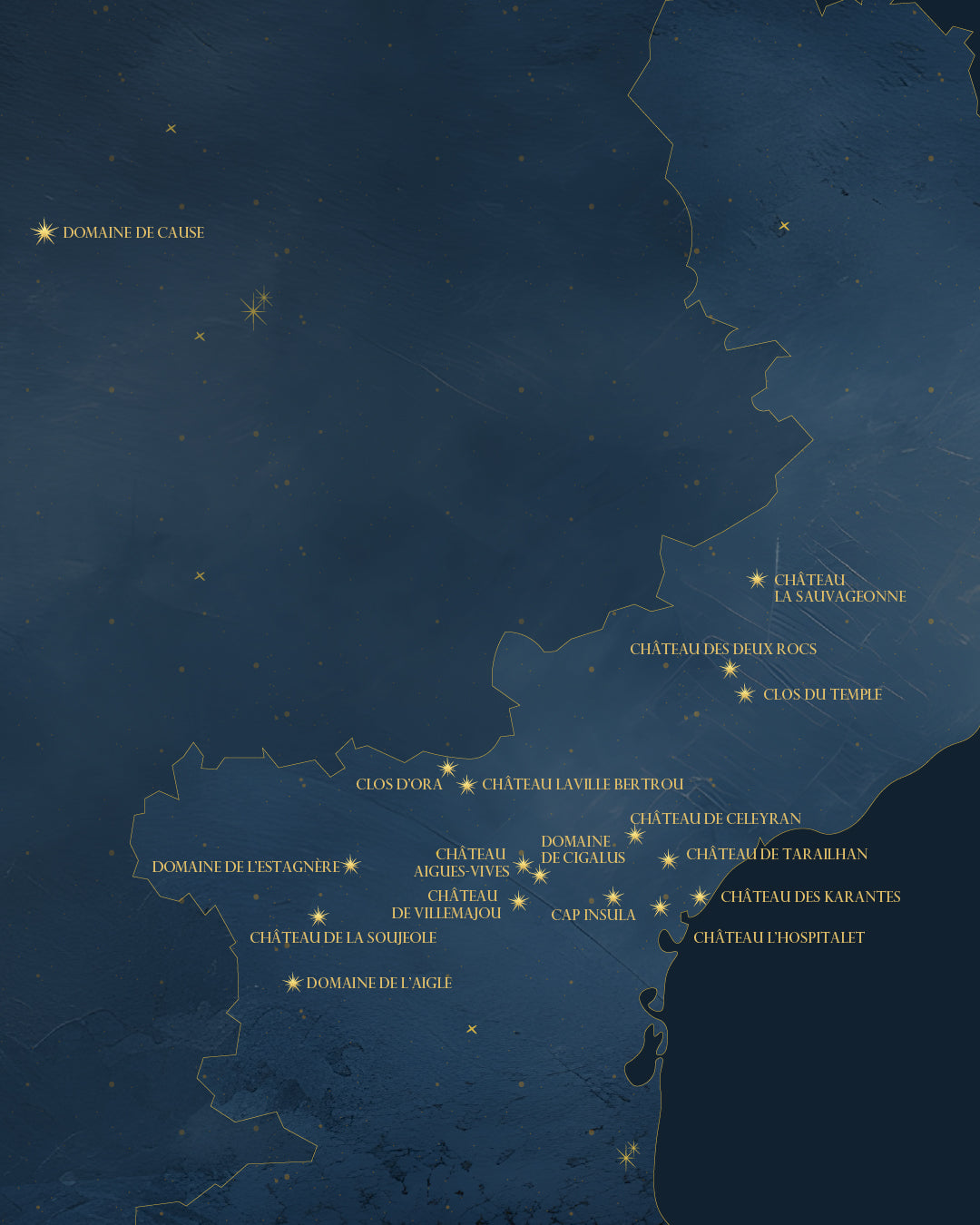
Discover the Gérard Bertrand domaines:
- His vinevard estates of Languedoc-Roussillon
- His expertise in the creation of biodynamic wines
These wines are popular right now
Our latest news

Last days to enjoy the wine fair
The Wine Fair ends tomorrow. You have just a few hours left to finalise your selection and check out before the offer ends. The most sought-after wines are the first to sell out: until 10 ...
Read the article
2026 24 Cuvées Advent Calendar: The New Gérard Bertrand Selection
Discover the new 2026 edition of the Gérard Bertrand 24 Cuvées Advent Calendar: 24 cuvées, 23 grape varieties and 14 certified organic or biodynamic wines, to enjoy every day in December.
Read the article
Héritage Tautavel 2023, No. 1 in the Top 100 Best Buy Wines 2026 by Wine Enthusiast
With a score of 94/100, Héritage Tautavel 2023 claims 1st place in the Top 100 Best Buy Wines 2026 by Wine Enthusiast, an international recognition celebrating the quality and character of this cuvée.
Read the article
DELIVERY IN 48H
Order and be delivered in 2 days anywhere in France, 5 days for Europe.

Secure payment
Protected transactions for a confident shopping experience.

Customer service
A question? Need advice? Our customer service team is here for you.

quality guaranteed
Every bottle is carefully selected to offer the very best.