
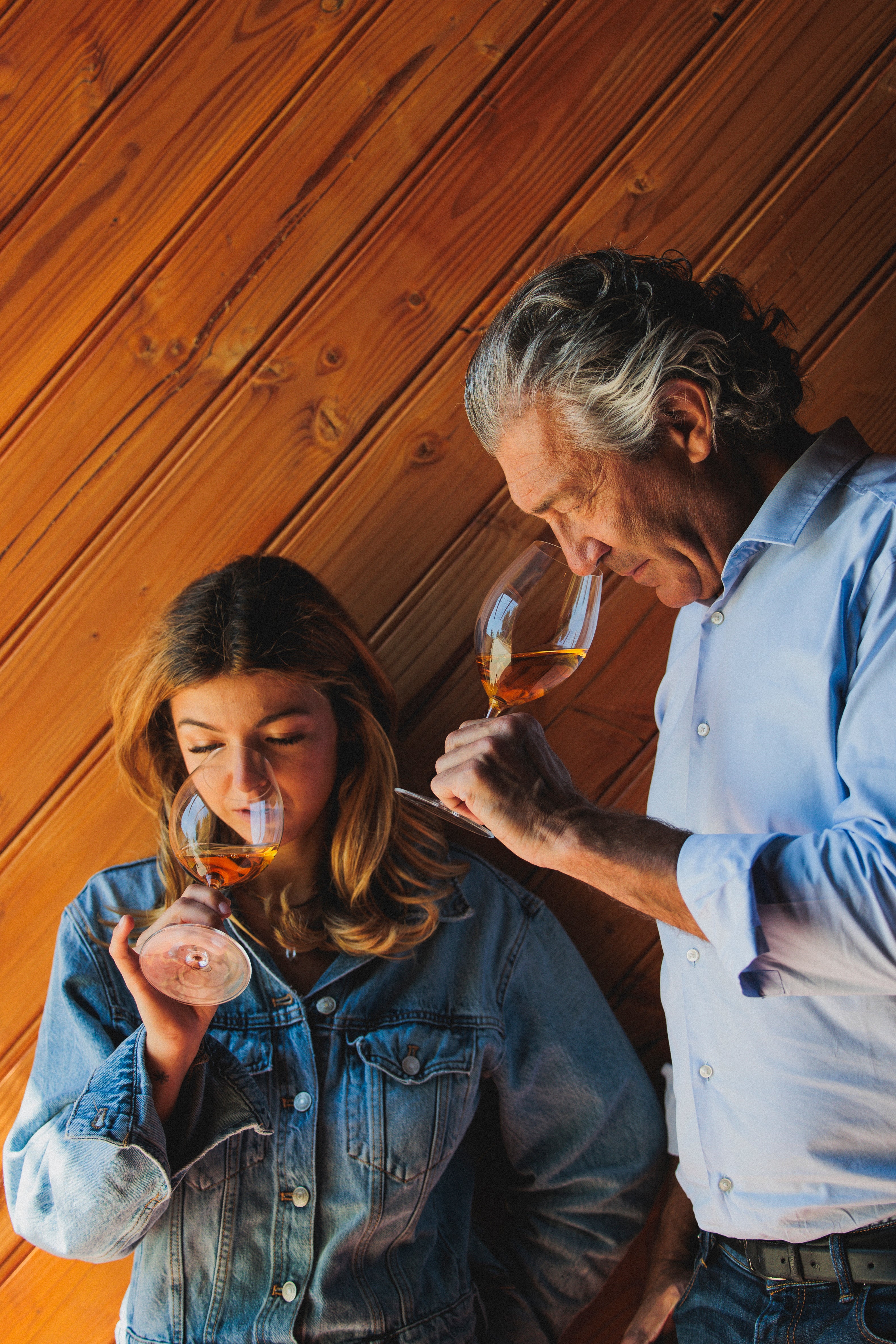
The Bertrand family
Orange wine defined in one sentence
Orange wine is a white wine made like a red wine: its white grapes macerate with their skins, seeds and sometimes stems for several days to several months before pressing. This skin maceration gives it its distinctive amber colour, subtle tannins and aromas of ripe fruit, sweet spices and dried fruit not found in classic white wine.
Skin maceration: how it works
Three winemaking families differ in the length of contact between the juice and the grape skins. For a classic white wine, grapes are pressed immediately: the juice is separated from the skins before fermentation, resulting in a pale colour and a tannin-free structure. For a red wine, the juice ferments in contact with the skins and seeds, which provide colour, tannins and body. Orange wine applies this second principle to white grape varieties: the must remains in a vat, barrel or jar with its skins for part of the fermentation.
The duration of this maceration varies greatly depending on the desired style. The lightest cuvées macerate for a few days to a few weeks for moderate tannin extraction. The International Organisation of Vine and Wine (OIV) sets the minimum duration of long skin maceration at one month. Traditional Georgian methods go even further: the Imeretian method lasts 15 to 30 days, while the Kakhetian method, practised in buried terracotta jars called qvevris, can last up to six months.
| Style | Maceration time |
|---|---|
| Light, fruity orange wine | A few days to 2–3 weeks |
| Long maceration (OIV standard) | From 1 month |
| Imeretian Georgian method | 15 to 30 days |
| Kakhetian Georgian method (buried qvevri) | Up to 6 months |
The longer the maceration, the more tannins, texture and ageing potential the wine gains; the shorter it is, the more freshness and fruit it retains.
Grape varieties used for orange wines
Orange wine is not a grape variety but a method: in theory, any white grape variety can be made into orange wine. In French vineyards, the most commonly used varieties are Chardonnay, Viognier, Roussanne, Grenache White, Marsanne, Clairette, Mauzac and Muscat. Internationally, Rkatsiteli, a Georgian grape variety historically associated with this winemaking method, is also used, as is Ribolla Gialla in Italy's Friuli region, a pioneer of the revival of orange wine in Europe in the 1990s.
Aromatic grape varieties such as Viognier and Muscat bring pronounced floral and exotic notes; more structured varieties such as Roussanne and Chardonnay provide more body and ageing potential. Blending several grape varieties, as Gérard Bertrand does, makes it possible to strike this balance between substance and freshness.
Gérard Bertrand orange wine: biodynamics and Languedoc
Based in the Mediterranean terroirs of Languedoc, Gérard Bertrand makes its orange wines from organically grown grapes, with a minimal-intervention approach consistent with the biodynamic philosophy guiding all the estate’s vineyards. The collection now includes five cuvées, each with its own identity:
- Orange Gold — a blend of Chardonnay, Grenache White, Viognier, Marsanne, Mauzac, Muscat and Clairette, with semi-carbonic maceration followed by barrel ageing. Notes of peach, apricot and mirabelle plum. Rated 92/100 by Bettane+Desseauve 2026.
- Art de Vivre orange — an accessible organic cuvée, rated 90/100 by Bettane+Desseauve 2026.
- French Cancan Brut Orange Bio — a sparkling version of orange wine, named best orange wine at the Master Winemaker Awards.
- Naturae — an organic, vegan cuvée with no added sulphites.
- Villa Soleilla — a premium biodynamic cuvée, available in a magnum gift box.
This diversity of blends and methods reflects Gérard Bertrand’s approach: making orange wine not a one-off stylistic exercise, but a fully fledged expression of the Languedoc terroir, alongside the estate’s red, white and rosé wines.
How to enjoy orange wine (temperature + food pairings)
Orange wine is enjoyed neither like a white nor a red: its tannic structure and aromatic richness call for a serving temperature slightly higher than that of a classic white wine, around 12 to 14 °C, allowing its aromas to express themselves without muting its tannins.
At the table, it pairs with dishes that traditional white wine can sometimes struggle to match: spicy or umami-rich cuisines (curry, spicy Asian dishes, ginger), charcuterie, mature cheeses, roast poultry and mushroom-based dishes. Its tannic substance and slight controlled oxidation make it a versatile gastronomic wine, halfway between white and red.
FAQ
What is the difference between orange wine and white wine?
The difference lies in contact with the grape skins. A classic white wine is pressed immediately, without maceration; an orange wine, made from the same white grape varieties, macerates with its skins for several days to several months, giving it its amber colour, tannins and more intense aromas.
Is orange wine sweet or dry?
The vast majority of orange wines are dry. Their amber colour may suggest a sweet wine, but it comes from skin maceration, not residual sugar: the style is generally closer to a tannic red wine than a sweet white wine.
How long can you keep a bottle of orange wine?
Thanks to its tannins, orange wine generally keeps longer than classic white wine: 2 to 5 years depending on the cuvée, and longer for wines made with extended maceration. Once opened, the bottle keeps like a structured white wine, for a few days in the fridge.
Is orange wine made with oranges?
No: no oranges are used in its production. The name comes solely from the amber to orange colour the wine takes on during skin maceration, a phenomenon purely linked to the winemaking of white grapes.
Where can you find a good organic French orange wine?
Languedoc, the historic birthplace of biodynamics in France, is one of the most active regions for organic orange wine. Gérard Bertrand offers a collection of five cuvées there, from entry-level organic wines to prestigious biodynamic cuvées.
Discover our orange wine collection
To find out more about the history of this macerated wine, visit our page Orange wine, from yesterday to today.